Blog
A practical guide for B2B buyers on design safety, material integrity, and regulatory compliance
Introduction: The Hidden Risk in Multi-Component Designs
Teethers are designed to be chewed, tugged, and mouthed for extended periods. This repeated mechanical stress—combined with the fact that teethers are used by babies who are still developing their swallowing and gag reflexes—makes design safety critical.
Multi-component teethers (those assembled from separate parts) introduce an inherent risk: parts can separate. When a teether breaks apart, small pieces can become choking hazards. This is not a theoretical concern. The U.S. Consumer Product Safety Commission (CPSC) has long regulated small parts in toys intended for children under three, with teethers explicitly included in the product categories subject to small parts testing .
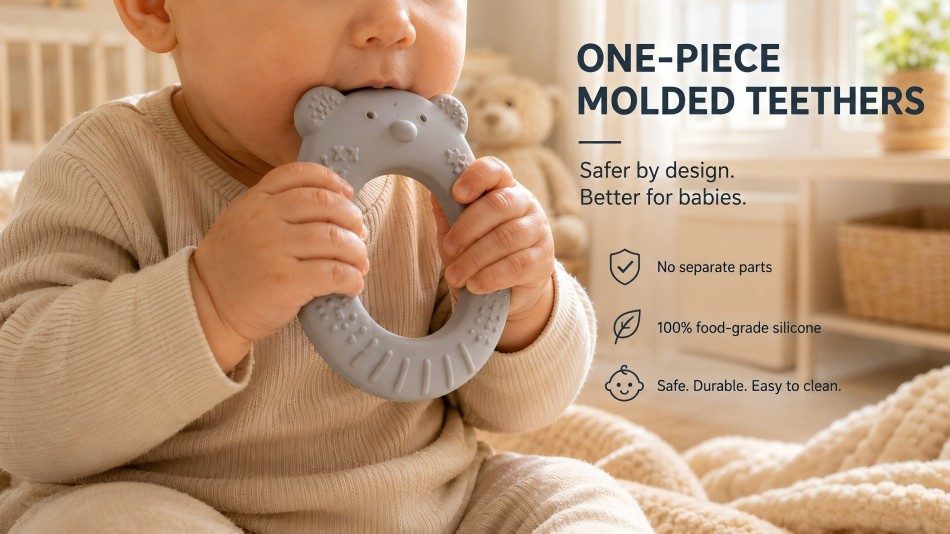
One-piece molded teethers address this risk at the design stage. Because there are no separate parts to detach, the choking hazard is minimized before the product is ever manufactured. However, this does not mean that multi-component teethers are inherently unsafe—it simply means they require more rigorous engineering, precision assembly, and quality control to ensure safety .
Part 1: The Choking Hazard Problem
How Multi-Component Teethers Can Fail
Multi-component teethers can fail in several ways:
Failure Mode | Example | Consequence |
Breakage into small pieces | Rings that crack and fragment | Small parts can be swallowed or inhaled |
Detachment of assembled parts | Clips separating from teether | Loose pieces become choking hazards |
Material degradation at joints | Silicone tearing at connection points | Sharp edges or detached fragments |
The CPSC has specifically noted that teethers should be checked for small parts or ends that could extend into the back of the baby's mouth, and that teethers should not have rough edges that could cut a baby's lips or gums . These safety concerns apply to both one-piece and multi-component designs.
What Makes Multi-Component Teethers Safe
Multi-component teethers can be safe when manufactured with:
Precision engineering that ensures components are securely joined and will not separate under the mechanical stress of chewing, pulling, and dropping
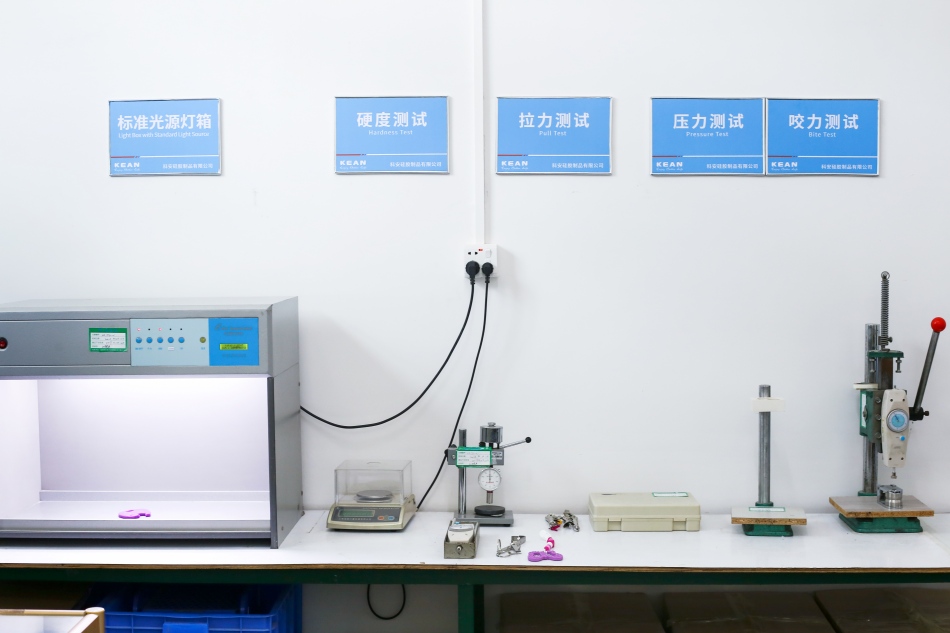
Rigorous testing to simulate real-world use, including torque, tension, and impact tests
Quality control processes that inspect every product for assembly defects before it reaches the customer
High-quality materials that do not degrade at connection points
The key distinction is design intent and execution. A well-engineered multi-component teether from a reputable manufacturer with strong quality control is far safer than a poorly made one-piece teether from an unreliable supplier .
Part 2: One-Piece Design—The Gold Standard for Risk Reduction
Why One-Piece Design Solves the Problem
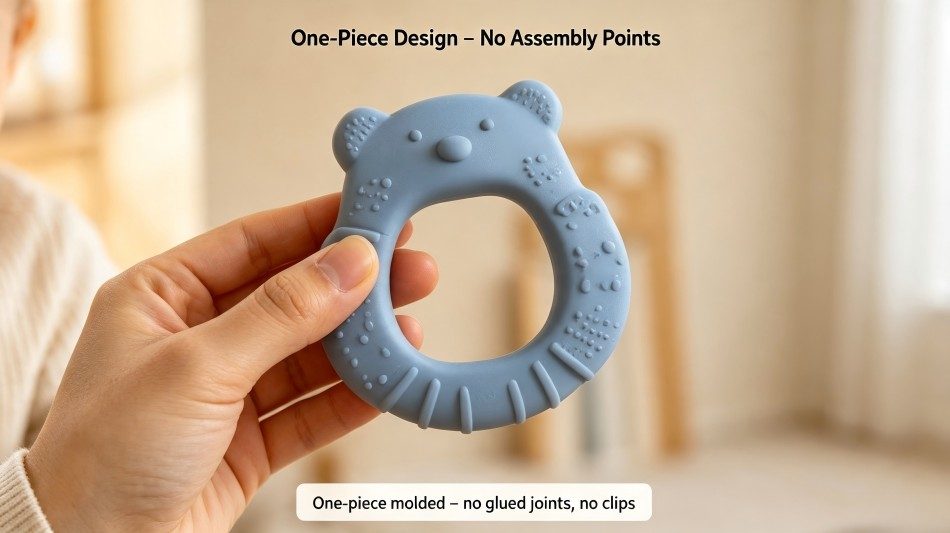
A one-piece molded teether is manufactured as a single, continuous piece of material. There are no seams, no glued joints, and no separate components that can be pulled apart. As one patent for a one-piece pacifier and teether assembly explains: "The one piece design minimizes the risk of choking due to the fact that there are not multiple components which may be easily separated".
One-piece LSR injection molding eliminates weak bonding points, reducing the risk of component separation under bite force . The logic is simple: if there are no separate parts, there are no parts to detach.
Material Consistency and Durability
One-piece molded teethers are made from a single material with consistent properties throughout, eliminating weak points at material junctions or seams—areas where multi-component teethers are most likely to fail. The material consistency also means no adhesives or bonding agents are required, removing the risk of chemical exposure from glues or the structural failure of adhesive joints.
Design Simplicity
Products with one-piece construction are inherently simpler to test for compliance. There are no separate components that each need to be evaluated for small parts risk or material safety.
Part 3: The Engineering and Quality Control Imperative
Whether a teether is one-piece or multi-component, its safety ultimately depends on the manufacturer's engineering expertise and quality control systems. The CPSC requires that teethers undergo use and abuse testing to simulate the rough treatment they will receive during normal use .
What Responsible Manufacturers Do
Quality Control Element | What It Covers |
Incoming material inspection | Verify food-grade silicone purity and certification |
In-process quality control | Monitor dimensions, hardness, and surface defects during production |
Final inspection (AQL sampling) | Check every batch for visual defects and structural integrity |
Third-party lab testing | Confirm compliance with FDA, LFGB, EN71, and CPSIA |
Batch traceability | Track raw materials to finished goods |
Liquid silicone rubber (LSR) injection molding offers distinct advantages for teether production: it allows precise hardness control (typically Shore A 30–50), ensures gentle gum stimulation while maintaining durability, and provides excellent elastic recovery after deformation without cracking .
The Role of Design Engineering
Safe teether design requires scientific evaluation of:
Overall dimensions—must be larger than infant throat diameter to prevent choking
Rounded edges and smooth transitions—prevents cuts and gum injury
Controlled thickness—avoids collapse or tearing under repeated biting
Surface texture engineering—effective gum massage without sharp micro-edges
An experienced manufacturer understands these engineering principles and integrates them into product development from the start.
Part 4: Regulatory Standards and Compliance
Key Safety Requirements
For teethers sold in the United States, compliance with the following is required:
Standard/Regulation | What It Covers |
Prevents choking hazards for children under 3 | |
Use and abuse testing—simulates rough treatment | |
Pacifier-specific requirements (for teether clips) | |
Lead and phthalate limits for children's products | |
Toy safety standard (mechanical, flammability, heavy metals) |
Products intended for export must meet additional requirements:
Market | Key Standard |
European Union | |
European Union | |
Germany | |
United States |
What This Means for B2B Buyers
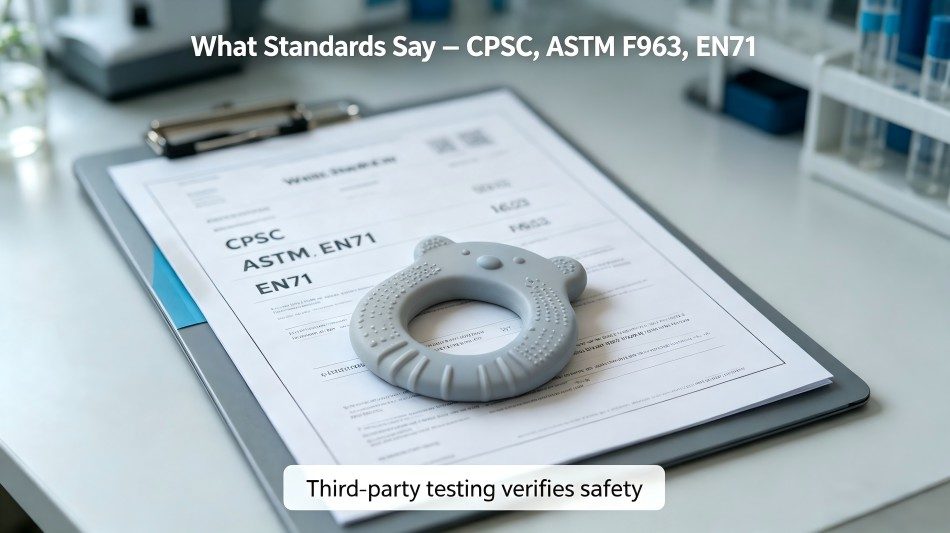
Regulatory compliance must be verified, not assumed. Test reports should come from accredited third-party labs (SGS, TÜV, Intertek) and should confirm both material safety and finished-product safety .
Part 5: What This Means for B2B Buyers
When sourcing silicone teethers, design safety should be a primary evaluation criterion. Here is what to look for:
Product Design
Feature | What to Look For | Why It Matters |
One-piece molded or precision-assembled | Single continuous piece or securely assembled multi-component | Minimises choking hazard from separated parts |
No adhesives | No glue or bonding agents | Eliminates chemical and structural failure risks |
No small parts | All components exceed CPSC small parts cylinder dimensions | Prevents choking |
Appropriate size | Teether is large enough not to be swallowed | Age-appropriate design |
Material and Certification
Requirement | What to Verify |
100% food-grade silicone | Material safety for oral use |
Platinum-cured | No byproducts; highest purity |
BPA-free, phthalate-free, PVC-free, lead-free | Regulatory compliance |
CPSC compliance | US children's product safety |
EN71 (if sold in EU) | Toy safety standard |
Third-party lab testing | Verified safety reports from accredited labs |
Supplier Evaluation Questions
Is the teether one-piece molded or precision-assembled from multiple components?
What engineering and quality control processes prevent part separation?
What testing has been conducted on the finished product?
Are test reports available from an accredited laboratory (SGS, TÜV, Intertek)?
Key Supplier Performance Metrics
Metric | Benchmark |
On-time delivery rate | |
Response time | |
Reorder rate |
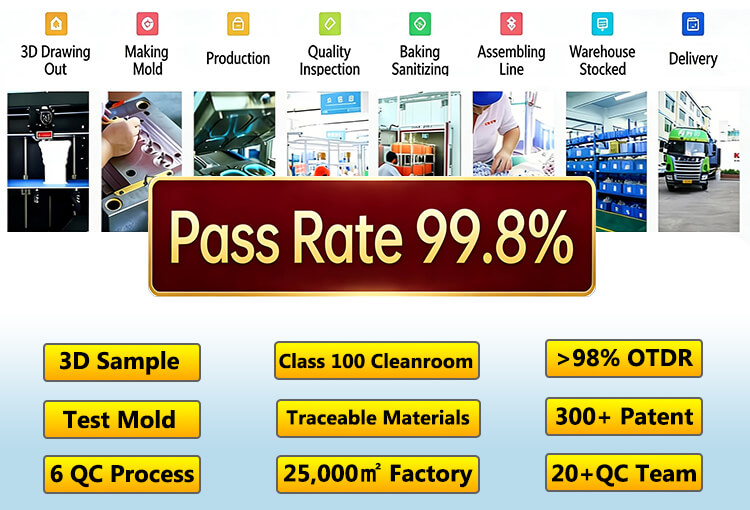
These metrics reflect operational reliability and manufacturer reputation .
Part 6: How KEAN Approaches Teether Safety
At KEAN Silicone, we recognize that safety is determined by the sum of material quality, engineering design, and manufacturing precision—whether a teether is one-piece or multi-component.
Our Manufacturing Capabilities
Established 2006 with a powerful design team of 10 creative professionals and a manufacturing team of 30 specialists
Own tooling department supporting both silicone injection tooling and hydraulic tooling—custom teether molds developed in-house for faster turnaround and better quality control
Liquid silicone rubber (LSR) injection molding for precision teethers, providing consistent texture, edge smoothness, and thermal stability
500k+ cycle mold lifespan, ensuring consistent quality across large production runs
Our Quality Control
Incoming raw material inspection, in-process quality control, and out-going quality control throughout our factory operations
Third-party lab testing for FDA, LFGB, EN71, and CPSIA compliance
Our Certifications
KEAN products and factory are certified to:
FDA, LFGB, EN71, CPSIA, CCPSA — product-level safety
BSCI, ISO9001 — factory-level social compliance and quality management
Our OEM/ODM Support
From design concept to mass production, KEAN supports brands with:
Custom colors (Pantone matching)
Custom logo (embossing, debossing, silk screen)
Custom packaging
Rapid sample turnaround — existing product: 1-2 days; custom design: 3-5 days
We understand that different brands have different design visions—and we have the engineering expertise to bring both one-piece and multi-component teethers to market safely and compliantly.
Conclusion: Safety Through Expertise, Not Just Design
One-piece molded teethers offer a clear safety advantage because they eliminate a fundamental risk: parts that can separate and become choking hazards. But a one-piece design alone does not guarantee safety—material quality, engineering precision, and quality control matter equally.
For B2B buyers, the key is to partner with a manufacturer who understands:
The science of teether structural design
The regulatory requirements of your target market
The importance of finished-product testing
The value of quality control throughout production
Whether you choose one-piece or multi-component teethers, safety comes from expertise, not just design.
This guide is based on CPSC regulations, manufacturer specifications, and product safety guidance. Contact KEAN Silicone for custom teether solutions—one-piece or multi-component—with full compliance documentation.